Anomaly or Deposit? The Question Every Soil Sample Answers
Cold open: 300 ppm Cu. Now what?
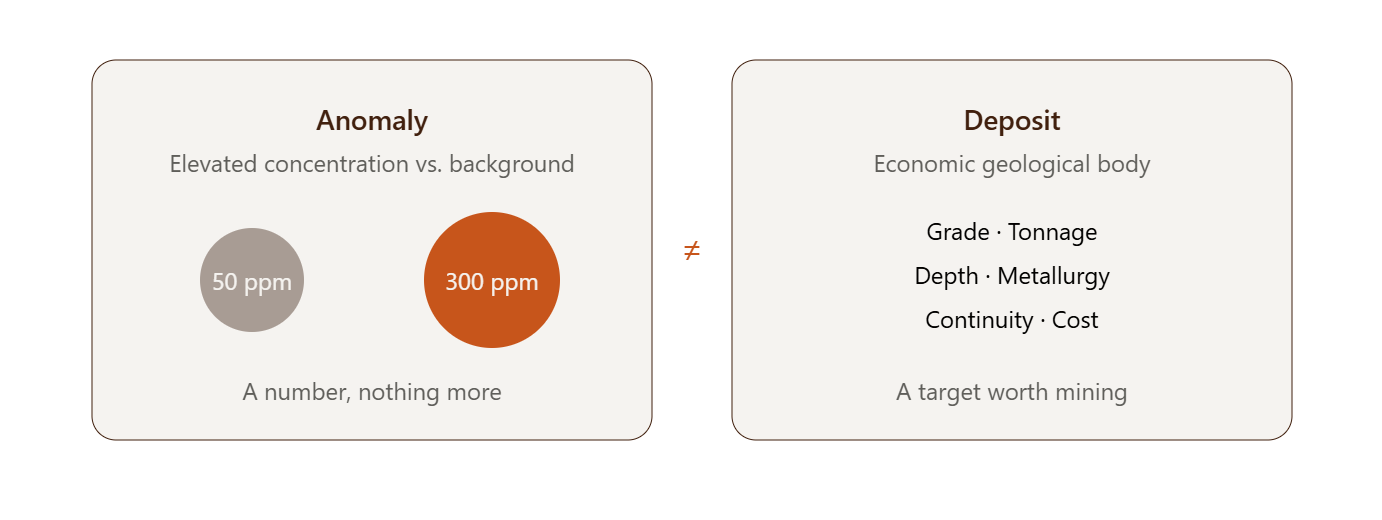
A soil sample comes back from the lab at 300 ppm copper. Background for the area is 50 ppm. Six times background — exciting number on a spreadsheet.
But here’s the question every exploration geologist has to sit with before getting excited: does this number mean there’s ore in the ground, or does it just mean something unusual happened chemically?
Those are not the same question. This post is about the gap between them — and why understanding that gap is the difference between a smart drill program and an expensive
hole in barren rock
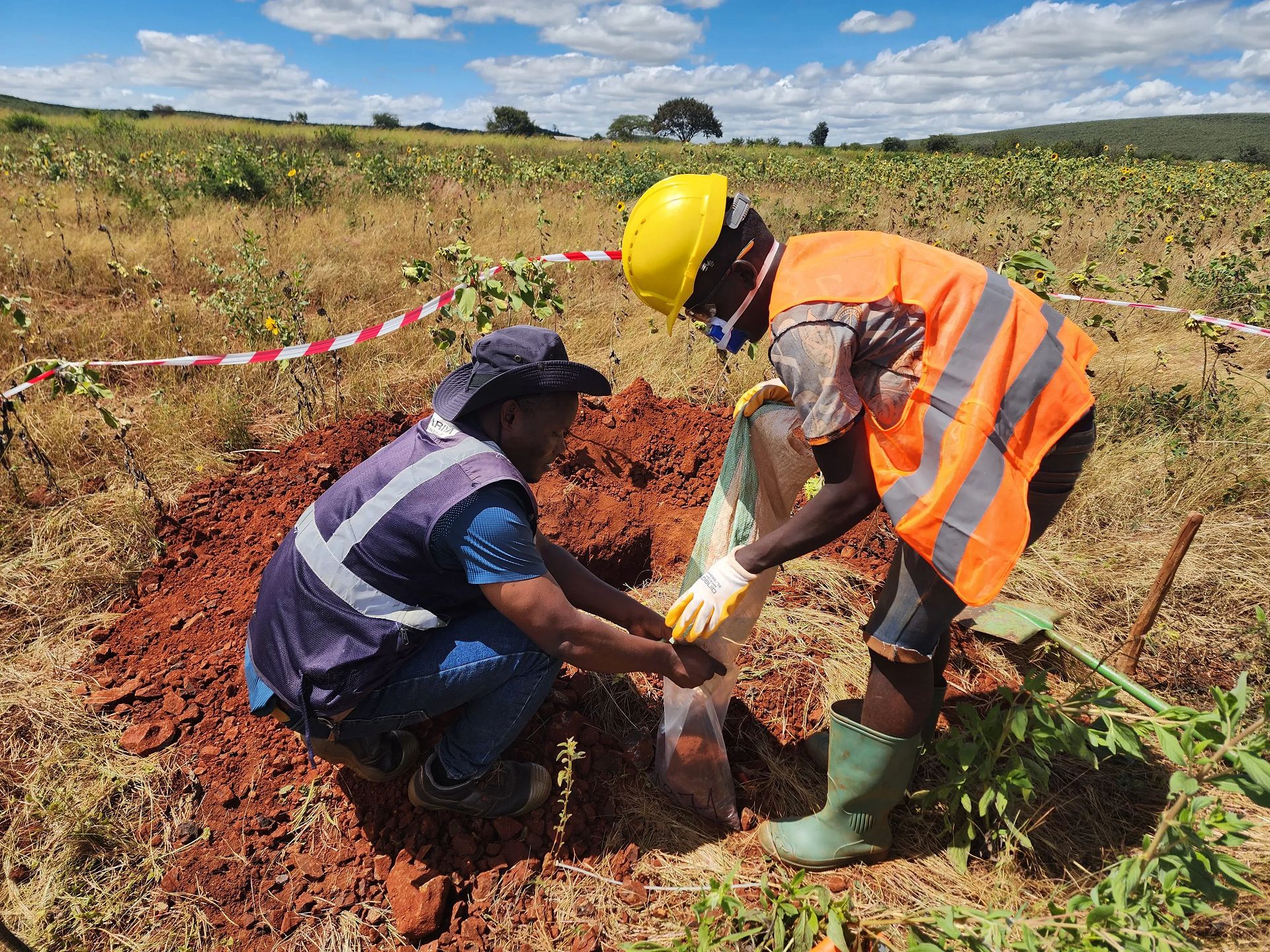
It’s a question our own team asks every day on the ground — whether we’re walking a graphite horizon in Tanga or Lindi, or logging soil pits across our Kahama, Nzega, and Geita
gold clusters in Tanzania
An anomaly and a deposit are not the same thing
A geochemical anomaly is simply an abnormal concentration of one or more elements relative to the local background. That’s it. It’s a statistical and chemical observation — nothing more.
A mineral deposit is a natural concentration of minerals with enough size, grade, continuity, and economic potential to be worth mining.
The 300 ppm Cu sample against a 50 ppm background is a textbook anomaly. It is not automatically a deposit. Anomalies like this can be produced by:
So the working rule exploration teams live by:
Every deposit should produce some geological or geochemical expression. But not every anomaly represents a deposit.
Why an anomaly doesn't guarantee an economic ore body
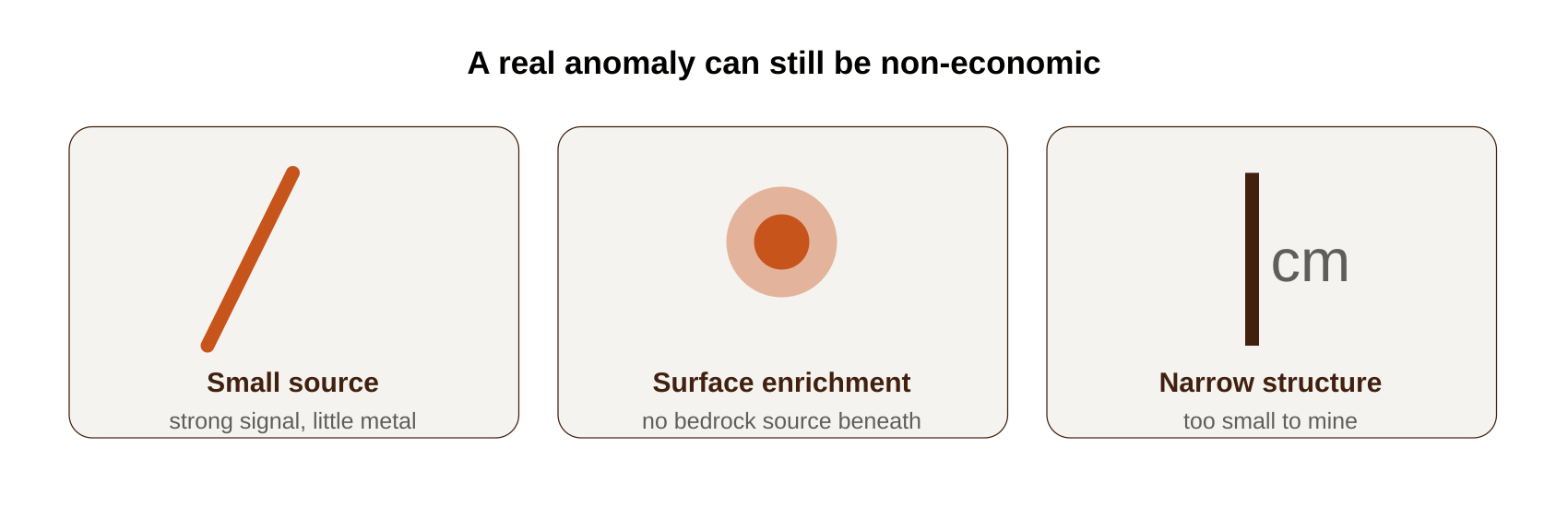
Even a real, geologically-caused anomaly can fail to add up to anything mineable. Economic viability depends on grade, tonnage, depth, metallurgy, continuity, and mining cost —
none of which a single soil sample can tell you.
A few of the more common ways a genuine anomaly turns out to be non-economic:
The shorthand worth remembering:
Anomaly = exploration target. Deposit = economic geological body.
An anomaly earns you the right to ask more questions. It doesn’t answer them
Can a real ore body hide from a soil survey completely?
Yes — and this might be the single most important (and counterintuitive) idea in exploration geochemistry. A perfectly good, economically mineralized ore body can produce no detectable soil anomaly at all.
How? A few well-documented ways:
Which leads to a rule that shapes how experienced geologists read a “blank” survey result:
Absence of anomaly ≠ absence of mineralization.
This is exactly why we run systematic, multi-phase soil surveys across our Tanzania projects — from the graphite horizons of Tanga and Lindi to gold targets at Jomu,
Kahama, and Geita — rather than relying on a single pass to tell the whole story.
Why soil geochemistry is an indirect method
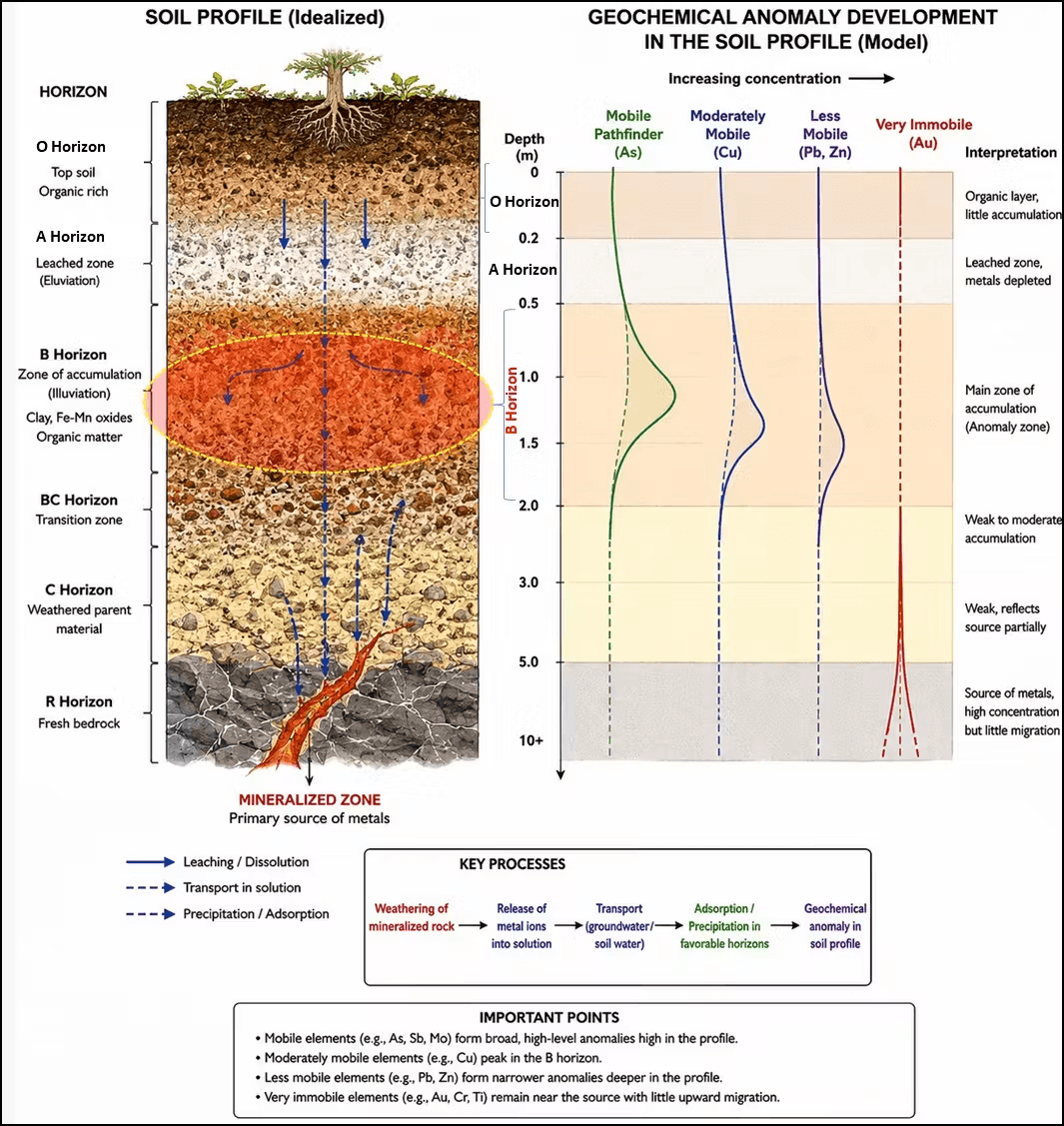
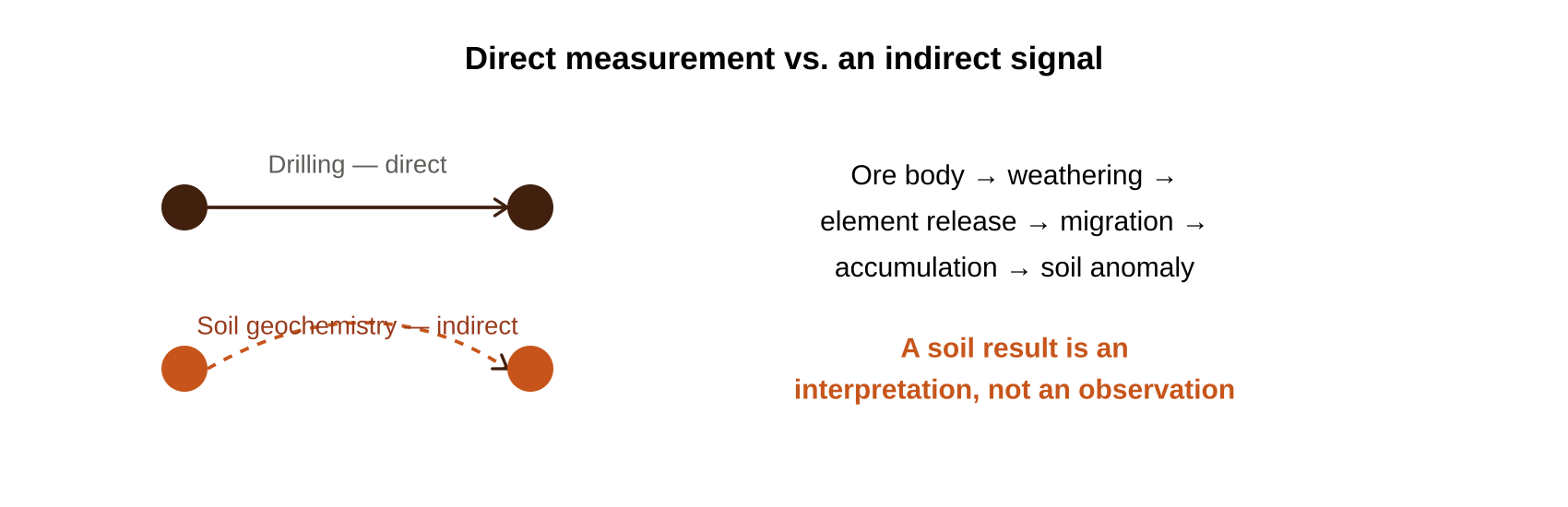
It’s worth being explicit about this, because it shapes how much weight a single result should carry. Soil geochemistry never observes the ore body directly. It observes the
downstream consequences: weathering products, dispersion patterns, secondary enrichment, and pathfinder elements.
The logic chain looks like this:
So what actually separates a real target from noise?
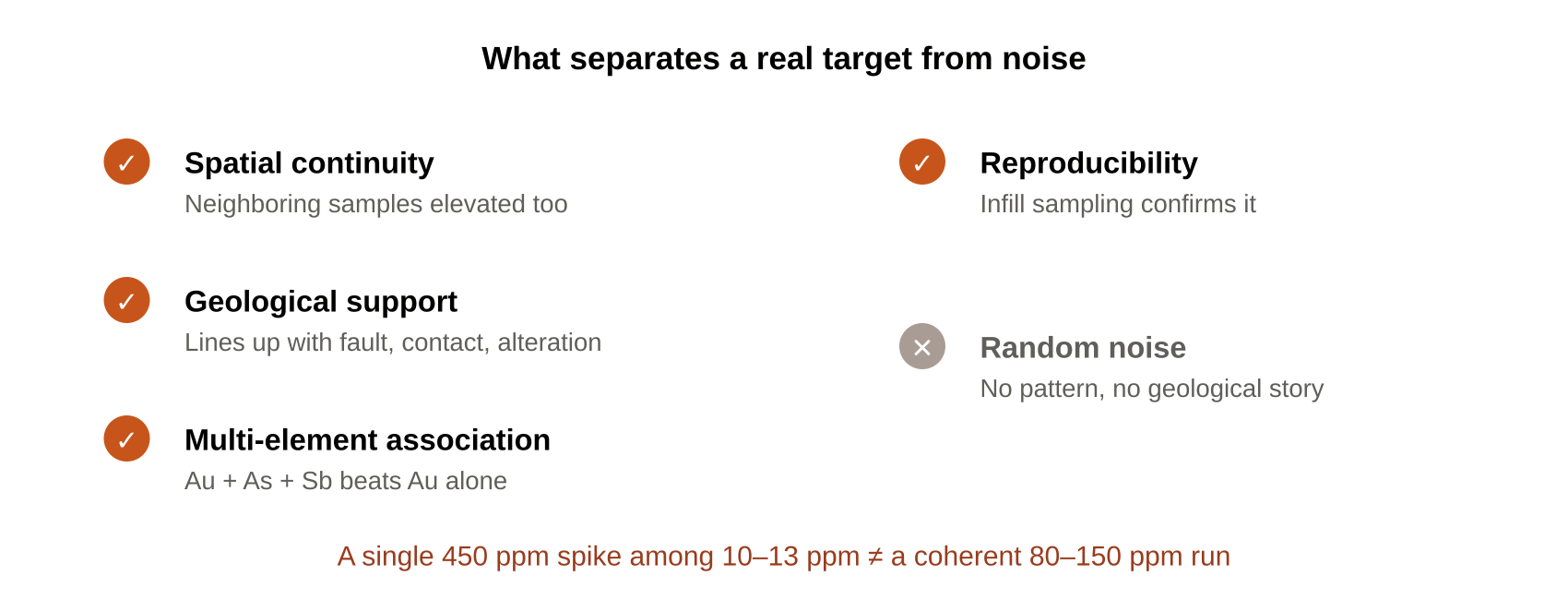
This is where interpretation earns its keep. A genuine anomaly tends to show:
Random noise, by contrast, lacks pattern, lacks continuity, and lacks a geological story to explain it. A single 450 ppm value sitting between a run of 10-13 ppm readings is more
likely contamination, assay error, or a stray float fragment than a real target. A coherent run — 80, 120, 150, 130, 90 — tells a geological story a spike alone never can.
This is also why background itself isn’t a fixed number. A Cu value of 100 ppm might be unremarkable in one lithology and strongly anomalous in another — background has to be
established within geological domains, not applied as a blanket threshold across a whole property.
This kind of rigorous, domain-by-domain interpretation is where technical exploration work and investor confidence meet. It’s also the discipline our sister company,
Sakariya Geo Services brings to due diligence and mineral exploration work across commodities and geographies.
The line that sums up the whole post
Exploration geologists have a saying for exactly this gap between a number and a target:
“Geochemistry finds anomalies. Geology finds deposits.”
A soil result on its own is just a number. Layered against structure, lithology, alteration, and tectonic setting, that same number becomes something worth drilling
Reshaping Resources, Responsibly — in Tanzania
At Sakariya, this is the discipline behind every soil program we run — across 21 prospecting licenses covering 460 sq km in our Kahama, Nzega, and Geita gold clusters, and
across our Tanga and Lindi graphite projects, where systematic pitting, trenching, and drilling have already confirmed multiple graphitic horizons with consistent grade continuity.